Wednesday, May 26, 2010

The First Food Markets in Ancient Rome


Long before that the Roman Forum began its activity, the Etruscans and the Romans used to meet and do business in a small area located between the Circus Maximus and the Tiber River. The reason of this choice was in the common worship of Hercules, who was not only popular for his famous 12 deeds but also because he was the patron of the olive trees. In the mythical accounts of Rome, Hercules killed the giant Cacus, who had previously stolen his cattle. After this event, the Romans built in his honor the Ara Maxima Herculis, that is located where today stands the basilica of Santa Maria in Cosmedin where the Mouth of Truth is. In addition, other temples were built in the early Rome to honor the harbor of Rome god, whose name was Tiberinus and new markets extended the areas between the Ara of Hercules and the Tiber with a new round temple dedicated to the Greek hero and two new markets dedicated to the purchase of cattle animals (Forum Boarium) and the vegetables (Forum Holitorium).

Tuesday, May 25, 2010

The Role of the Circus Maximus in Ancient Rome


From one side of the Palatine hill it is possible to admire the elongated form of the largest stadium built in the ancient world: the Circus Maximus. According to the historian Livy it was wanted by the Etruscan king Tarquinius Priscus to celebrate chariot races competition. The stadium could accommodate around 300 thousand people and had shops at the bottom of its structures. As we have discussed in the previous posts it was from there that the fire of Rome began in the year 62 CE also because at Nero's time the circus had the upper level seats still on wood. It was really a magnificent building that had an internal water channel that allowed the charioteers to better guide their performances and had also obelisks that were brought by the Roman emperors throughout the history as a plunder from Egypt.

Thursday, May 20, 2010

The Multiple Layers of the Caelian Hill


The Caelian Hill is one of the seven historical hills of Rome and is located between the Domus Aurea and the Colosseum. The etymology of the name is straightforward: the name may pertain to one of the Etruscan leaders, whose name was Caele Vibenna, who helped Servius Tullius to get into rhe supreme power in Rome. According to the emperor Claudius, whose dedicatory temple was built on purpose on the Caelian Mount, Caele Vibenna and Mastarna helped a new Etruscan family to get rid of Tarquinius Priscus. The emperor Claudius was the main scholar about the Etruscan world in antiquity but unfortunately we have lost his writings about the predecessors of the Romans. He revered so much the Etruscans and their religious institutions that we have recorded his speech about the importance of the study of the Etruscan in his Lyons tablets.

Tuesday, May 18, 2010

The Triumphal Processions in Ancient Rome

What already said about the triumphal arches in the Forum pertains to the general phenomenon of the triumphal processions. When the Romans arrived in Greece in the third century BCE, they began to discover how important was the self representation. Once they became aware of the Greek statues representing the deities in nude poses, they immediately realized that their carved heads can be placed on these marble bodies. Talented slaves working as artists in Rome implemented an enormous amount of imagery that dcorated the Roman houses but also the public squares in the Fora. As soon as the Romans, who were frugal by nature, initiated to collect these works of art, they became so fond of the Greek culture that some of the Roman emperors such as Hadrian and Marcus Aurelius spoke Greek. The Forum was the stage where all the major triumphal processions took place, and writers such as Livy and Plutarch give us many details on the display of the new stautes coming from the Eastern side of the Roman empire.

Sunday, May 16, 2010

The Palatine Hill in Ancient Rome


Coming down from the Forum on the way to reach the Colosseum, on the right side there is a hill that still today is visited not that often. The hill that we can still see from the second floor of the Colosseum is the hill where the first inhabitants of Rome settled and where archaeologists found remains of the thatched huts of the iron age. Indeed the Palatine has many layers. First of all ,20 feet down below there are the remains of the republican houses like the house of the Griffins, which is a good example of second style in Roma paintings. This mansion was then erased by the foundations of the Flavian Palaces built by Vespasian and Domitian in the years 80 - 90 CE. The last who improved the structured of the palatine was Septimius Severus with a monument that does not exist anymore: the Septizodium. If we really want to know how the Septizodium looked like before its demolition in the Renaissance time, we have to go to see the frescoes in the Sistine Chapel because Botticelli painted it when he needed a background for his panel frescoes.

Friday, May 14, 2010

The Arch of Constantine as Mix of Different Arches


When we look at the arch of Constantine, which is located just outside of the Colosseum, we have an impression of unity and harmony of its sculptural program. However, things are not easy when we deal with this arch. First of all, we have to understand that this arch was first built by Hadrian in 130 AD to glorify his beloved Antinous ,who is represented in the roundels of the monuments. Secondly, if we get closer to the arch, there is a difference in stiye at the moment of analyzing the carved panels. In fact, the roundels of Hadrian are different from the rectangular frieze panels: the panels show Constantine battling in Verona against Licinius and the battle of the Milvian Bridge when he defeated Maxentius and became the only Roman Emperor ruling the empire. Indeed all the arch is a puzzle, because at the moment of adding therectangular panels, Constantine added the attic on top with the famous inscription for which scholars are still debating.Therefore, the arch is from the bottom until the beginning of the attic Hadrianic, but in the attic and in the rectangular panels is Late Antique because of the linearity of its carvings and for the frontal disposition of the figures.

Wednesday, May 12, 2010

How did the Fire of Nero impacted Rome in 64 AD?


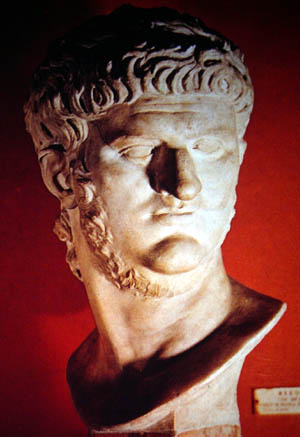
Many authors wrote in history that Nero had a pivotal role in burning Rome in 64 AD. Somebody says that his love for Greece made him dreaming of having a new marble city, somebody else says that he blamed the Christians for the flames that burned in Rome for one week. It's unknown ,however, if Nero intentionally burned Rome. Recent excavations conducted under the arcades of the Circus Maximus confirm that the fire started from that part of Rome: in fact many shops in ancient Rome had wooden furniture and a torch may have caused the disaster. Nero later on was hated more by the Romans because the residential area occupied today by the Colosseum was expropriated to build his own new house: the Domus Aurea. After having committed suicide, the senate decreed the Damnatio Memoriae and all the portraits of Nero were destroyed or carved again with the traits of his successors.